Aquatic Weed Control at Penrith Lakes
This project shows our innovative wetlands and waterways services as we implemented aerial drone spraying with on-water treatment methods to manage widespread aquatic weeds…
This project shows our innovative wetlands and waterways services as we implemented aerial drone spraying with on-water treatment methods to manage widespread aquatic weeds…
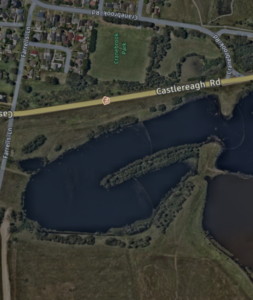
This project shows our innovative wetlands and waterways services as we implemented aerial drone spraying with on-water treatment methods to manage widespread aquatic weeds across Penrith Lakes. This resulted in controls of infestations whilst improving waterway health and accessibility across the site.
Our team conducts targeted treatment of aquatic weeds, including Salvinia molesta, Ludwigia longifolia, and Alternanthera philoxeroides, by integrating aerial and on-water control methods. For primary works, we engaged specialist contractors to operate drone aerial spraying, enabling precise and efficient application over extensive or difficult-to-access areas. Follow-up and maintenance treatments were carried out using chemical spray boat, which is equipped with a three-boom spray set-up, allowing for spray widths between 4 and 10 meters per pass. This method is particularly effective for managing Salvinia molesta infestations in open water and targeting aquatic weeds that are inaccessible from the embankment or via road and foot access.
 |  |
| Follow-up with chemical spray boat | Maintenance phase |
 |  |
| Before | After |
Over multiple years, we restored key wetland habitats within the Sydney Airport precinct, balancing ecological rehabilitation with aviation safety requirements. Through our weed management…
Over multiple years, we restored key wetland habitats within the Sydney Airport precinct, balancing ecological rehabilitation with aviation safety requirements. Through our weed management services, we transform degraded areas into strong ecosystems.
We successfully completed a multi-year bush and wetland regeneration project for our client, Sydney Airport, spanning from 2019 to 2022. The project began with a focus on intensive primary works to control dense infestations of invasive species such as Cestrum parqui (Green Cestrum), Lantana camara, Chrysanthemoides monilifera subsp. rotundata (Bitou Bush), Ludwigia peruviana (Water Primrose), and various exotic climbers. These weeds were treated in staged sections to support effective restoration and site recovery.
Sydney Airport’s vision was to rehabilitate the riparian habitat around two wetland ponds, creating a functional and resilient natural area while minimising the risk of attracting large bird populations near the airport. Our team worked to achieve this balance by restoring native vegetation and managing habitat complexity appropriately.
From 2020 to 2022, we carried out regular maintenance works to consolidate earlier progress. Weed densities were effectively maintained or reduced across most work zones, with major improvements noted in Engine Pond West, Engine Pond East , and Mill Stream . Native vegetation showed strong regeneration, supported by our follow-up work and favorable seasonal rainfall.
In 2022, the final year of the contract, our efforts shifted to controlling vine and herbaceous weeds such as Rumex sagittatus and Anredera cordifolia, particularly in areas with good native cover or previous plantings. We also carried out supplementary planting to increase biodiversity, enhance habitat corridors, and reduce future weed re-establishment in cleared zones.
Throughout the project, a diverse range of native fauna were observed, including Striped Marsh Frogs, Eastern Water Skinks, Blue-tongued Skinks, Black Swans, Pelicans, Honeyeaters, Swamp Hens, and Superb Fairy-wrens — highlighting the ecological value of this urban stepping stone habitat.
This project was completed to a high standard, with all objectives met through careful planning, consistent follow-up, and strong teamwork. It stands as a successful example of large-scale ecological restoration in a complex urban setting.
 |  |
| Before | After |
 |  |
| Before | After |
At Sydney Olympic Park’s Brickpit, we delivered a specialised habitat project designed to protect and support local frog populations. Through our ecology restoration services,…
Read More Brickpit Green and Golden Frog Habitat Construction 2024
At Sydney Olympic Park’s Brickpit, we delivered a specialised habitat project designed to protect and support local frog populations. Through our ecology restoration services, we created a functional and resilient habitat within this highly sensitive environment.
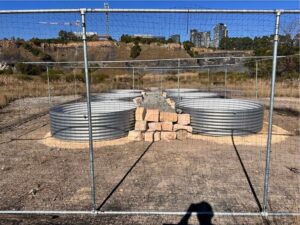
In March and April 2024, our team delivered a specialised on-ground project at the Brickpit, focused on ecological protection and habitat support. The works involved the placement of six metal tanks within a rigid frame enclosure, expertly wrapped in taut, commercial-grade bird netting.
This design was carefully constructed to exclude medium to large birds while allowing frogs to freely enter and exit. Transporting the tanks from the Brickpit car park to the site, we arranged them on a level sand bed reinforced with coir logs and connected them via frog-accessible gabion pathways. The entire enclosure stands at approximately 2 metres high and was engineered with steel supports and lockable, bird-proof access doors.
Despite biosecurity restrictions and limited site access via a dirt track, our team ensured high standards in ecological restoration and wetland enhancement, contributing to a secure, functional habitat within this sensitive, sandstone-based environment.
 |  |
| Our skilled staff completing construction with care and precision. | Tanks arranged on a leveled bed of brickies sand, with coir logs installed to prevent erosion as per project specifications |
 | 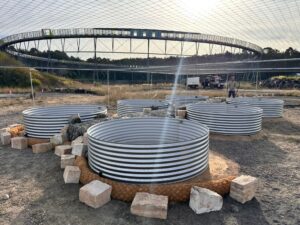 |
| Completed installation of bird-proof netting—commercial grade, black, UV-resistant, and secured at the base to allow frog access while excluding larger birds | All done! Construction completed and site ready for action. |
Our team delivered Bush Regeneration and Revegetation services at Dee Why Dunes which spanned over 11 hectares. Our work here used targeted and innovative…
Our team delivered Bush Regeneration and Revegetation services at Dee Why Dunes which spanned over 11 hectares. Our work here used targeted and innovative techniques that produced effective results.
Project Outcomes:
Our team delivered Stage 2 bush regeneration works at Dee Why Dunes between January and June 2024 under Northern Beaches Council Bush Regeneration contract 2023. This project, covered approximately 11.32 ha across three zones that was on the foundations of the Year 1 grant and complemented ongoing operational regeneration efforts. Our focus was on controlling invasive species and restoring the native dune ecosystem through a combination of innovative and targeted techniques.
A major achievement was the effective management of Ipomoea cairica using a shredding technique within Ficinia nodosa, which allowed access to mature vine bases with minimal herbicide use. This method has proven successful and will inform future control strategies. Our team also conducted extensive preparation and planting in key areas, including the zone north of the overflow carpark and the bay near the toilet block. Invasive species like Pennisetum clandestinum and Asparagus aethiopicus were treated using hand removal, shredding, and spot-spraying.
New plantings of native species, including Banksia integrifolia and native ground covers, have supported erosion control and improved biodiversity. Weed density ratings improved noticeably. These results included an increase from ‘fair’ to ‘good’ in the southern dune zone, and ‘poor’ to ‘fair’ along the lagoon edge. These results highlight the effectiveness of our targeted approach. Moving forward, continued management of Ipomoea cairica, regular site maintenance, and strategic planting will be essential to further enhance the site’s ecological resilience.
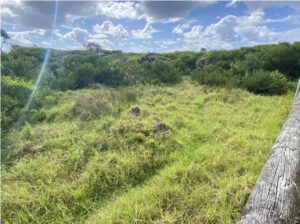 | 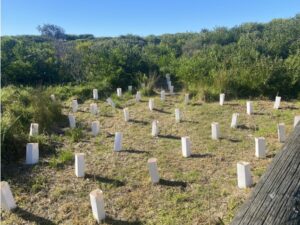 |
| Before | After |
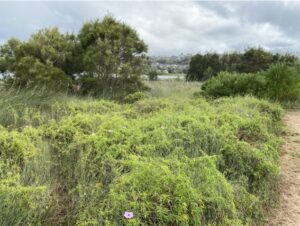 | 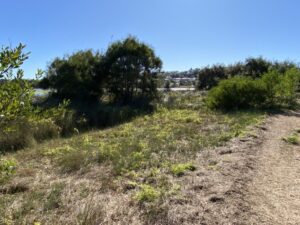 |
| Before | After |
10 Site Project We are working with Sydney Water to carry out bush regeneration and weed management works across ten of their sites over…
10 Site Project
We are working with Sydney Water to carry out bush regeneration and weed management works across ten of their sites over the next six years! Our team is highly skilled in these areas and specialises in rehabilitating various sites like these. We are undertaking works on the following sites:
Caddies Creek and Smalls Creek (Rouse Hill Development Area)
Our team has been undertaking primary clearing of woody weeds (primarily Lantana camara, Ligustrum lucidem, Cestrum parquii and Ligustrum sinense) and treatment of vines such as Lonicera japonica, Anredera cordifolia, Acetosa sagittata and Cardiospermum grandiflorum. We focused on completing primary works in the early months of winter to minimise the disturbance of local fauna who would use the thickets of woody weeds to nest or roost in in Spring/Summer. We have raked back sections of Tradescantia fluminensis and flame weeded the ground along sections of Smalls Creek to try and stimulate native regeneration.
Elizabeth Macarthur Creek, RHDA
Maintenance works throughout the project site has been regularly conducted. Our priority treatment has been on noxious weeds while also managing treatment for environmental weeds and vines. Additionally, we have been conducting aquatic weed management throughout the whole site. We have also monitored the amount of debris accumulating along the creek line and removed it as required.
Breakfast Creek, Quakers Hill
The site has progressed very well as our services significantly reduced woody weeds and improved the overall flow of the creek line. The targeted removal of Erythrina crista-galli throughout the creek has been conducted. We have also had the canopy lifted in order to limit the amount of debris caught up. Additionally, brushcutting of reeds on the upper banks will allow for a better flow of water to come through as well as reduced nutrient levels on the banks, limiting weed growth. Further works will involve treatment of emerging vines throughout the site and the removal of sediment and rubbish including trolleys to improve the water flow and quality.
Eve Street Wetland, Arncliffe
Our team have focused on reducing herbaceous weed levels while doing staged, primary treatment of woody weeds for this site.
Freshwater Creek
We have been undertaking aquatic weed control, herbaceous weed treatment as well as focused control of Asparagus asparagoides and Bryophyllum delagoense around all the planting beds as well as around the endangered Acacia pubescens.
Cooks River Campsie and Canterbury
Manual removal of herbaceous annuals and grasses throughout the site has been conducted. We also spot sprayed young, herbaceous annuals with a selective herbicide. We monitor the site for any new weed incursions and the fence line for any structural issues.
Our team has been transplating Commelina cyanea into the lower slopes of the naturalised area to encourage a dense native groundcover.
We have been maintaining the sections of Saltmarsh via careful manual removal of herbaceous species and Cynodon dactylon while monitoring the growth of mangroves.
Prospect Nature Reserve, Prospect
We have focused our efforts on undertaking bush regeneration through the riparian zone of this site. We will be revegetating sections with low resilience with provenance species.
Woollahra Wetland, Double Bay
Our works have targeted aquatic weed control throughout the whole site. This includes the aquatic weeds Salvinia molesta and Ludwigia peruviana. Working on this site we have ensured the outlet and inlet channel can flow freely while allowing the gross pollution trap (GPT) to be accessed.
O’Neill Park Yagoona
Maintenance works have been targeting herbaceous species throughout the zone on the eastern side of the creek. Regular monitoring will be carried out for any aquatic weeds on site and will be treated appropriately if needed.
Here are some of the photos of the rare and threatened flora and fauna on our sites:

Our project aimed to create a breeding haven for the Green and Golden Bell Frog to support population growth for this declining species. The…
Our project aimed to create a breeding haven for the Green and Golden Bell Frog to support population growth for this declining species.
From landfill and brick pits to golf courses, Green and Golden Bell Frogs have a peculiar habit of appearing in unlikely and disturbed habitats. Once an extremely common species across all of Sydney, now has only about 40 of its population left. The species has been suffering an ongoing decline and shrinking of their distribution since the 1970s. Loss of ideal habitat, and pressures from predators including native waterbirds, introduced Mosquito Fish and feral cats, are contributing factors behind why they are being found in degraded and unlikely habitats. This presents an urgent need for the creation and restoration of high quality, predator free habitat for the species.

Our team has been working with the Sydney Olympic Park Authority to manage existing ponds to bring back much needed habitat for the Green and Golden Bell Frog. Kronos Hill is a wildlife corridor extending for 1.5km encompassing an area of remediated landfill adjacent to Haslam’s Creek. Currently there are a range of restoration projects being undertaken at the site. The pre-existing site’s ponds were suffering from sedimentation and were lacking appropriate shelter to protect struggling local Green and Gold Bell Frogs from predators.

To address these issues and provide a stable habitat for the species our team worked on restoring the ponds. We first started by draining existing water from the site’s ponds to eradicate the introduced Mosquito Fish. These Mosquito Fish decimate Green and Golden Bell Frog tadpoles, therefore hindering local breeding populations. Our team then removed thick accumulated sediment. This assisted in making way for the installation of impermeable pond liners, facilitating improved water retention and conforming to Green and Golden Bell Frog preference for habitat disturbance. Frog-friendly netting was then installed above the ponds to reduce predator access to breeding frogs and tadpoles. Due to the species apparent preference for ephemeral ponds and fluctuating water levels, the ponds were filled naturally with rainwater and runoff over time to entice the species to disperse to the site.

Continuing our support for the Green and Golden Bell Frog, this project not only aimed to provide the species with a safe space to live, but also to provide a breeding haven, free from the pressures of predators and degraded habitat. Our efforts will hopefully result in unhindered breeding site and facilitate increased dispersal of the species to other potential habitat sites in the locality.