Oliver Guerrisi-Watson
Site Supervisor
Oliver started working with the naturalenvironment in wine making in Italy. Whilecompleting studies in languages at SydneyUniversity, Oliver developed his personalinterest in native bushland, being a keenbushwalker. He completed his Certificate III inCLM and has developed excellent plantidentification skills over the last 3 years.Hetakes a ‘life cycle’ approach tobushregeneration, understanding the long termgoals and benefits of restoring and maintainingthe natural environment.He leads his project teams by example, with ahands on approach, he is highly motivationaland a positive member of the Dragonfly team.
Qualification
Certificate III in Conservation and Land Management / First Aid / AQF3 Chemical Application / Chem Certificate 2,4D / Frog Handling and Training /
WorkCover WHS General Inductionof Construction Industry NSWWhite Card
Project by this member
Frogbit control works (14 sites)
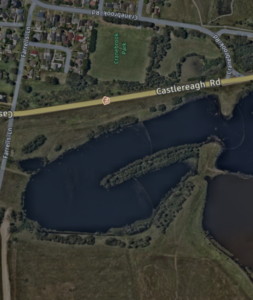
Clients: Hawkesbury River Council Location: Scarborough Ponds East Project Duaration: 2022 – 2024 Method & Technic: Aquatic Weed Treatment Broadscale Herbicide Spraying Project Outcomes:…
Frogbit control works (14 sites)
| Clients: | Hawkesbury River Council |
| Location: | Scarborough Ponds East |
| Project Duaration: | 2022 – 2024 |
Method & Technic:
- Aquatic Weed Treatment
- Broadscale Herbicide Spraying
Project Outcomes:
Intensive management of Limnobium laevigatum with a goal to achieve 80% reduction of priority weeds through primary, secondary and maintenance weed control.
![]() | ![]() |
| Before | After |
![]() | ![]() |
| Before | After |
Warriewood Wetlands 2021-Present
Clients: Northern Beaches Council Location: Warriewood Wetlands Project Duaration: 2021-Present Method & Technic: Aquatic Weed Treatment Save our Species Broadscale Herbicide Spraying Endangered Ecological…
Warriewood Wetlands 2021-Present
| Clients: | Northern Beaches Council |
| Location: | Warriewood Wetlands |
| Project Duaration: | 2021-Present |
Method & Technic:
- Aquatic Weed Treatment
- Save our Species
- Broadscale Herbicide Spraying
- Endangered Ecological Communities
- Revegetation
Project Outcomes:
Our team worked to restore and maintain the Endangered Ecological Community Swamp Sclerophyll Forest on Coastal Floodplain / Swamp Mahogany Forest in Warriewood Wetlands, adapting to the challenges of heavy rainfall and fluctuating hydrology. We focused on regular site monitoring, targeting exotic vines, annual weeds, and aquatic invasives like Ludwigia peruviana and Erythrina crista-galli. A balanced approach of spot spraying and manual removal allowed us to allocate resources effectively, prioritising degraded areas. With the support of Northern Beaches Council, we revegetated key zones, replacing dense woody weed incursions with native plantings. This methodical approach has proven successful.
![]() | ![]() |
| Before | After |
![]() | ![]() |
| Before | After |
Scarborough Ponds East 2022 – Present
Clients: Bayside Council Location: Scarborough Ponds East Project Duaration: 2023 – Present Method & Technic: Aquatic Weed Treatment Broadscale Herbicide Spraying Bush Regeneration Revegetation…
Scarborough Ponds East 2022 – Present
| Clients: | Bayside Council |
| Location: | Scarborough Ponds East |
| Project Duaration: | 2023 – Present |
Method & Technic:
- Aquatic Weed Treatment
- Broadscale Herbicide Spraying
- Bush Regeneration
- Revegetation
Project Outcomes:
Our team focused on maintaining and restoring the Endangered Ecological Communities of Swamp Oak Floodplain Forest, Swamp Sclerophyll Forest, and Sydney Freshwater Wetlands at Scarborough Ponds during the 2023-2024 contract period. We prioritised the Melaleuca Swamp Forest and previously revegetated areas, ensuring their resilience against invasive species.
Primary works targeted Erythrina sp. infestations, while regular maintenance controlled encroaching vines, grasses, and herbaceous weeds across the site. The extended warm season and frequent rain events resulted in significant weed blooms, requiring much of the effort to be focused on maintenance rather than expanding new restoration areas.
To further strengthen the site’s ecological recovery, 1,000 native tube stock plants were introduced, enhancing biodiversity and supporting future restoration efforts. Moving forward, maintaining established areas remains a priority before expanding primary works to new zones.
![]() | ![]() |
| Before | After |
![]() | ![]() |
| Before | After |
Coolibah Reserve Creek and Wetland Bush Regeneration Work 2020-2023
Clients: Bayside Council Location: Scarborough Ponds East Project Duaration: 2020-2023 Method & Technic: Aquatic Weed Treatment Bush Regeneration Revegetation Project Outcomes: Dragonfly Environmental was…
Read More Coolibah Reserve Creek and Wetland Bush Regeneration Work 2020-2023
Coolibah Reserve Creek and Wetland Bush Regeneration Work 2020-2023
| Clients: | Bayside Council |
| Location: | Scarborough Ponds East |
| Project Duaration: | 2020-2023 |
Method & Technic:
- Aquatic Weed Treatment
- Bush Regeneration
- Revegetation
Project Outcomes:
Dragonfly Environmental was engaged to deliver long-term ecological restoration and stormwater management improvements at Coolibah Reserve and along Bardwell Creek and Bardwell Wetland. The project spans over 3.7 hectares and forms the final section of the Bardwell Creek Biodiversity Corridor, connecting to the broader Wolli Creek system.
Prior to 2020, our team undertook significant revegetation efforts along Bardwell Creek and Wetland, including the installation of 27,500 native plants—400 of which were advanced 8” aquatic species. These foundational works contributed to the establishment of riparian vegetation and set the stage for long-term ecological recovery and water quality improvement.
By 2023, Coolibah Reserve supported a mosaic of regenerating native bushland, remnant canopy trees, stormwater filtration zones, and revegetated riparian corridors. These areas collectively support two Endangered Ecological Communities (EECs): Swamp Oak Floodplain Forest and Swamp Sclerophyll Forest.
During the most recent contract period, our team carried out both primary and maintenance works across all five zones of the reserve. While routine sweeps targeted common weed incursions, primary works focused on degraded pockets, gradually improving site resilience while enhancing biodiversity and visual amenity. Zones 3 and 5 saw particularly notable improvements, with successful expansion of revegetated areas helping stabilize the creek line and prevent further erosion.
Weed control efforts significantly reduced the presence of high-priority species such as Tradescantia fluminensis and Anredera cordifolia, while regular management helped suppress annual herbaceous weeds. Despite these gains, areas impacted by nutrient-rich stormwater runoff remain a challenge and will benefit from ongoing restoration and support.
Revegetation works have played a key role in expanding the ecological corridor and improving the site’s function as a filter for urban runoff. Future work is recommended to continue in alignment with the current strategy, with increased planting and mulching to support newly established zones, improve visual presentation, and suppress invasive grasses.
This project stands as a strong example of how targeted revegetation, weed control, and habitat corridor restoration can meaningfully improve biodiversity, ecological function, and landscape aesthetics in urban environments.
![]() | ![]() |
| Before | After |
![]() | ![]() |
| Before | After |
Aquatic Weed Control at Penrith Lakes
This project shows our innovative wetlands and waterways services as we implemented aerial drone spraying with on-water treatment methods to manage widespread aquatic weeds…
Aquatic Weed Control at Penrith Lakes
This project shows our innovative wetlands and waterways services as we implemented aerial drone spraying with on-water treatment methods to manage widespread aquatic weeds across Penrith Lakes. This resulted in controls of infestations whilst improving waterway health and accessibility across the site.
Skill sets used:
- Aquatic Weed Treatment
- Broadscale Herbicide Spraying
- Drone Technology Aerial Spraying
Project Outcomes:
Our team conducts targeted treatment of aquatic weeds, including Salvinia molesta, Ludwigia longifolia, and Alternanthera philoxeroides, by integrating aerial and on-water control methods. For primary works, we engaged specialist contractors to operate drone aerial spraying, enabling precise and efficient application over extensive or difficult-to-access areas. Follow-up and maintenance treatments were carried out using chemical spray boat, which is equipped with a three-boom spray set-up, allowing for spray widths between 4 and 10 meters per pass. This method is particularly effective for managing Salvinia molesta infestations in open water and targeting aquatic weeds that are inaccessible from the embankment or via road and foot access.
![]() | ![]() |
| Follow-up with chemical spray boat | Maintenance phase |
![]() | ![]() |
| Before | After |
Gardens of Stone National Park Bush Regeneration
Working within the Gardens of Stone National Park, we implemented our weed control services to protect native habitats and threatened species. After our treatment…
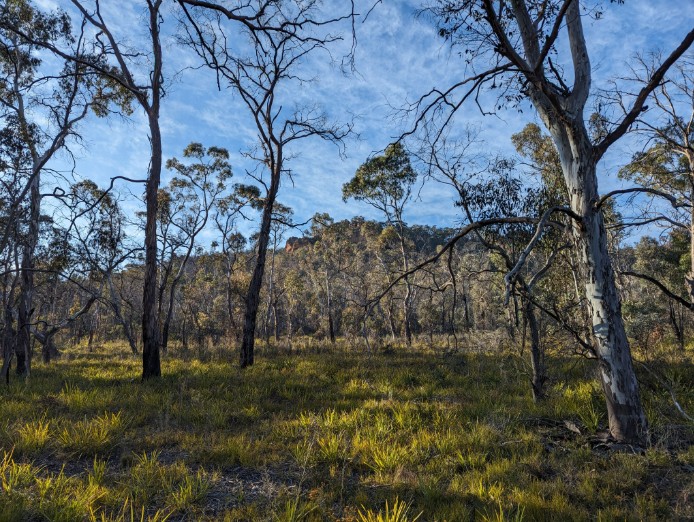
Gardens of Stone National Park Bush Regeneration
Working within the Gardens of Stone National Park, we implemented our weed control services to protect native habitats and threatened species. After our treatment of invasive species, the project has transitioned into a careful maintenance phase to support long-term ecosystem health.

Method & Technique:
- Bush Regeneration
- Targeted Weeding
Project Outcomes:
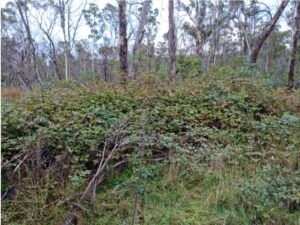
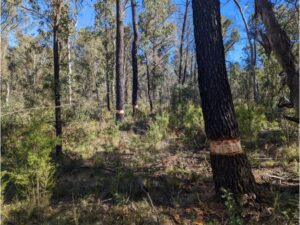
Our team successfully completed the primary weed control program targeting Blackberry (Rubus fruticosus agg.) at Gardens of Stone National Park, an area recognised for its significant birdlife and threatened species habitat. In addition, invasive Monterey Pine (Pinus radiata) was treated using the ringbarking method to prevent further encroachment into native vegetation The work was carried out by our experienced and AQF3 SMARTtrain Chemical Accreditation certified personnel, using appropriate herbicide application methods to ensure effective treatment while taking extra care to minimise impacts on native flora and fauna. We have now entered the maintenance phase, with ongoing, carefully managed follow-up treatments to support the long-term protection of this sensitive ecosystem.
![]() | ![]() |
| Large incursions of Rubus fruticosa | Large incursions of Rubus fruticosa |
![]() | ![]() |
Pinus radiata ring Barked with chainsaws | Afte photo of Ring Bark treatment |